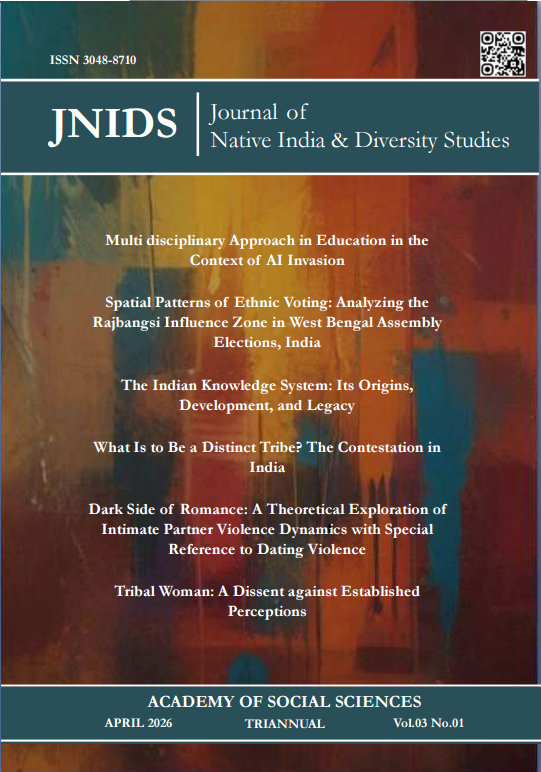
The Indian Knowledge System: Its Origins, Development, and Legacy
DOI:
https://doi.org/10.62656/Keywords:
Indian Knowledge System, Vedic Tradition, Ayurveda, Indian Philosophy, NEP 2020, EpistemologyAbstract
The Indian Knowledge System (IKS) represents one of the world’s oldest and most comprehensive intellectual traditions. Rooted in the Vedic corpus and developed through centuries of philosophical inquiry, scientific exploration, and cultural evolution, IKS encompasses disciplines such as philosophy, mathematics, astronomy, medicine, linguistics, governance, and arts. Unlike fragmented modern epistemological structures, IKS is
characterized by its holistic integration of spiritual, empirical, and ethical dimensions of knowledge. This paper explores the origins of IKS in the Vedic and pre-Vedic periods, examines its systematic development during classical and medieval eras, and analyzes its enduring legacy in contemporary education and global intellectual discourse. Special attention is given to the philosophical foundations, scientific achievements, and pedagogical traditions that define IKS. The study also highlights the relevance of IKS in the twenty-first century, particularly in light of the National Education Policy (2020), which emphasizes the integration of traditional knowledge systems into modern curricula. The paper concludes that IKS is not merely a historical legacy but a dynamic intellectual framework capable of contributing meaningfully to contemporary global challenges.
References
1. Brahmagupta. (628 CE/2007). Brahmasphutasiddhanta (Classical text).
2. Dasgupta, S. (1922). A history of Indian philosophy (Vols. 1–5). Cambridge University Press.
3. Government of India. (2020). National Education Policy 2020. Ministry of Education.
4. Panini. (4th century BCE/1997). Ashtadhyayi (Sanskrit grammar treatise).
5. Radhakrishnan, S. (1923). Indian philosophy (Vols. 1–2). George Allen & Unwin.
6. Sushruta. (c. 600 BCE/2008). Sushruta Samhita (Ancient medical text).